Multi-head Latent Attention (MLA) has two mathematically equivalent execution forms. The naive form up-projects the compressed latent back into per-head keys and values and then runs ordinary MHA. The absorbed form folds the up-projection matrices into the query and the output, so attention runs directly on the latent, which behaves like a single shared (MQA-style) KV head.
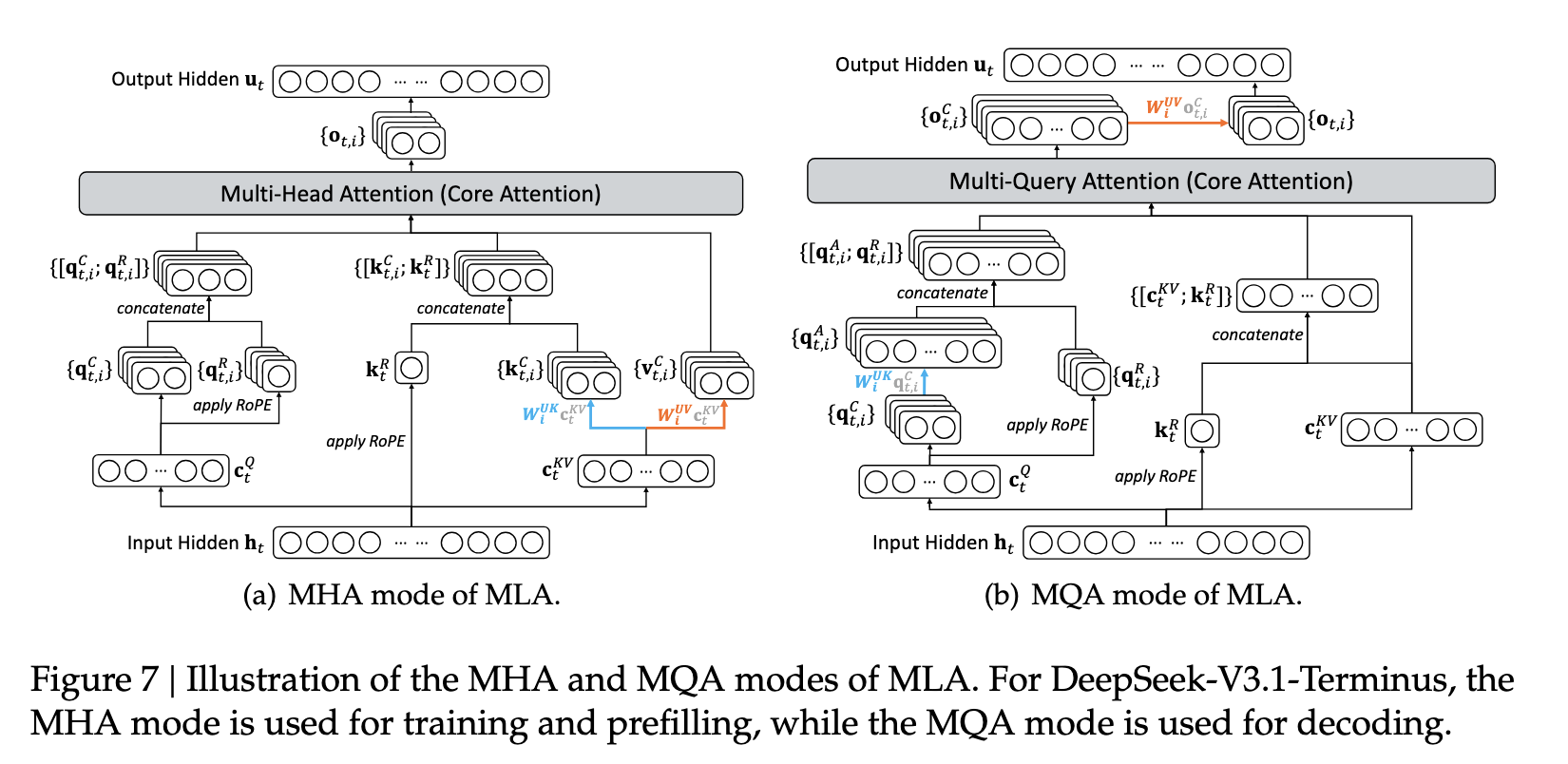
Figure 7 of the DeepSeek-V3.2 technical report. The paper calls these the MHA mode (a) and the MQA mode (b) of MLA; this post calls them naive and absorbed. The coloured arrows are the two absorption identities derived below: in (a), $W^{UK}_h$ and $W^{UV}_h$ are applied to the cached latent to rebuild per-head keys and values; in (b) the same two matrices have moved — $W^{UK}_h$ onto the query ($\mathbf{q}^C \to \mathbf{q}^A$) and $W^{UV}_h$ onto the output ($\mathbf{o}^C \to \mathbf{o}$) — so core attention runs against a single shared $[\mathbf{c}^{KV}_t; \mathbf{k}^R_t]$ entry. The paper’s caption states the decision rule this post derives from first principles: MHA mode for training and prefilling, MQA mode for decoding.
They produce identical outputs from identical weights. They do not have identical cost, and the difference is sharply localized:
- Token-linear FLOPs are exactly the same. Absorption moves work around; it does not remove it.
- Core attention FLOPs differ by a fixed factor — $3.4\times$ for the DeepSeek-V3 shape, independent of head count and sequence length.
- Memory traffic differs by ~$71\times$ on the same shape, in the opposite direction.
That asymmetry is the entire decision rule. Dense causal attention is core-attention-dominated, so it keeps the naive form. Decoding and sparse attention are memory-dominated, so they take the absorbed form and eat the FLOPs.
The Absorption Identity
MLA caches a compressed latent $\mathbf{c}^{KV}_t \in \mathbb{R}^{d_c}$ per token and reconstructs keys and values from it with per-head up-projections $W^{UK}_h$ and $W^{UV}_h$.
Indices: $i$ = query position (attention row; just one during decode), $j$ = key position (column, over the cached tokens $j \le i$), $h$ = head. So $\mathbf{h}_i$ is the hidden state at $i$ and $\mathbf{c}^{KV}_j$ the cached latent at $j$.
The score is two independent contractions added together — a non-positional (“nope”) part over $d_{\text{nope}} = 128$ dims and a decoupled RoPE part over $d_{\text{rope}} = 64$ — and the attention weight is the softmax of their sum:
$$ s_{h,ij} = s^{\text{nope}}_{h,ij} + s^{\text{rope}}_{h,ij}, \qquad p_{h,ij} = \operatorname*{softmax}_{j\,\le\,i}\; \frac{s_{h,ij}}{\sqrt{d_{\text{nope}} + d_{\text{rope}}}} $$Only the first term absorbs. It is
$$ \begin{aligned} s_{h,ij}^{\text{nope}} &= \left( W^{Q,\text{nope}}_h \mathbf{h}_i \right)^\top \left( W^{UK}_h \mathbf{c}^{KV}_j \right) \\ &= \underbrace{\left( \left(W^{UK}_h\right)^\top W^{Q,\text{nope}}_h \mathbf{h}_i \right)}_{\text{absorbed query } \tilde{\mathbf{q}}_{h,i} \in \mathbb{R}^{d_c}}{}^{\top} \; \mathbf{c}^{KV}_j \end{aligned} $$Matrix multiplication is associative, so $W^{UK}_h$ can be applied once to the query $i$ instead of to every key $j$. The key never has to exist.
The RoPE term does not absorb. Writing $R_i$ for the rotation at position $i$, and using $R_i^\top R_j = R_{j-i}$:
$$ s^{\text{rope}}_{h,ij} = \left(R_i W^{QR}_h \mathbf{h}_i\right)^{\!\top} \left(R_j W^{KR} \mathbf{h}_j\right) = \mathbf{h}_i^\top \left(W^{QR}_h\right)^{\!\top} R_{j-i}\, W^{KR} \mathbf{h}_j $$Two things to read off this. $W^{KR}$ carries no head index — there is one $64$-dim rope key per token, shared by every head, and that is true in both execution forms; absorption is not what makes the rope side shared. And the $R_{j-i}$ wedged between the two projections depends on $i$ and $j$, so unlike $W^{UK}_h$ there is no fixed matrix to precompute into either side. That is why MLA carries a decoupled RoPE dimension at all, and why the absorbed score is computed as two matmuls that get summed rather than one.
Symmetrically on the output side — and note the sum runs over $\mathbf{c}^{KV}_j$ alone, so the value is $d_c = 512$ wide while the key is $512 + 64$:
$$ \mathbf{o}_{h,i} = \sum_{j \le i} p_{h,ij} \left( W^{UV}_h \mathbf{c}^{KV}_j \right) = W^{UV}_h \left( \sum_{j \le i} p_{h,ij}\, \mathbf{c}^{KV}_j \right) $$so $W^{UV}_h$ moves outside the sum: applied once per query $i$ instead of once per cached token $j$ — and the number of $j$ grows with sequence length while the number of $i$ does not.
The softmax sits between $W^{UK}$ and $W^{UV}$, so the two absorptions are independent of each other — and neither of them ever touches the rope slice. In the absorbed form the rope part contributes to the score and nothing else: it never reaches the output, which is why $W^{UV}_h$ is a $[d_v \times d_c] = [128 \times 512]$ matrix and dimensionally could not act on those 64 dims even if you wanted it to.
Reference Implementation
Both paths below share _project (the query/latent/RoPE front end) and the same weights, so the outputs must match numerically. forward_naive materializes full-size K/V; forward_absorbed folds W_UK into the query and W_UV into the output. Every line carries its tensor shape.
"""Minimal comparison: naive MLA vs. absorbed (matrix-absorption) MLA.

Shape names used in the trailing comments (default config in __main__):
    batch                      = 2
    seq       (seq_len)        = 512
    hidden    (hidden_size)    = 2048
    heads     (num_heads)      = 16
    q_lora    (q_lora_rank)    = 512
    kv_lora   (kv_lora_rank)   = 512     <- the compressed latent dim
    nope      (qk_nope_head_dim) = 128
    rope      (qk_rope_head_dim) = 64
    qk_dim    (nope + rope)    = 192     <- full per-head query/key dim
    v_dim     (v_head_dim)     = 128

Naive MLA:
    latent c_kv [batch, seq, kv_lora] --W_UK--> k_nope [batch, heads, seq, nope]
                                      --W_UV--> v      [batch, heads, seq, v_dim]
    then standard MHA over full-size k/v.  KV cache = k [heads, qk_dim] + v [heads, v_dim].

Absorbed MLA (what vLLM / SGLang do at decode):
    W_UK is folded into the query:  q' = q_nope @ W_UK   -> [batch, heads, seq, kv_lora]
    W_UV is folded into the output: o  = (attn @ c_kv) @ W_UV
    attention runs directly on the latent c_kv, which acts as a *single* shared
    (MQA-style) kv head.  KV cache = c_kv [kv_lora] + k_pe [rope] only.

Both paths use the exact same weights, so outputs must match numerically.
"""

import torch
from torch import nn


# --------------------------------------------------------------------------------------
# RoPE helpers (same as the HF DeepseekV3 implementation, non-interleaved variant)
# --------------------------------------------------------------------------------------
def rotate_half(x):
    x1, x2 = x.chunk(2, dim=-1)  # x [.., rope] -> x1 [.., rope/2], x2 [.., rope/2]
    return torch.cat((-x2, x1), dim=-1)  # -> [.., rope]


def apply_rope(q, k, cos, sin):
    # q [batch, heads, seq, rope] | k [batch, 1, seq, rope] | cos, sin [1, seq, rope]
    cos, sin = cos.unsqueeze(1), sin.unsqueeze(1)  # [1, seq, rope] -> [1, 1, seq, rope]  (broadcasts over batch/heads)
    q = q * cos + rotate_half(q) * sin  # [batch,heads,seq,rope] * [1,1,seq,rope] -> [batch, heads, seq, rope]
    k = k * cos + rotate_half(k) * sin  # [batch,1,seq,rope]     * [1,1,seq,rope] -> [batch, 1, seq, rope]
    return q, k


def build_rope(seq_len, dim, device, dtype, base=10000.0):
    inv_freq = 1.0 / (base ** (torch.arange(0, dim, 2, device=device).float() / dim))  # [rope/2]
    t = torch.arange(seq_len, device=device).float()  # [seq]
    freqs = torch.outer(t, inv_freq)  # [seq] x [rope/2] -> [seq, rope/2]
    emb = torch.cat((freqs, freqs), dim=-1)  # -> [seq, rope]
    return emb.cos().to(dtype)[None], emb.sin().to(dtype)[None]  # each [1, seq, rope]


# --------------------------------------------------------------------------------------
# MLA
# --------------------------------------------------------------------------------------
class MLA(nn.Module):
    def __init__(
        self,
        hidden_size=2048,  # hidden
        num_heads=16,  # heads
        q_lora_rank=512,  # q_lora
        kv_lora_rank=512,  # kv_lora
        qk_nope_head_dim=128,  # nope
        qk_rope_head_dim=64,  # rope
        v_head_dim=128,  # v_dim
    ):
        super().__init__()
        self.num_heads = num_heads
        self.kv_lora_rank = kv_lora_rank
        self.qk_nope_head_dim = qk_nope_head_dim
        self.qk_rope_head_dim = qk_rope_head_dim
        self.qk_head_dim = qk_nope_head_dim + qk_rope_head_dim  # qk_dim = nope + rope
        self.v_head_dim = v_head_dim
        self.scaling = self.qk_head_dim**-0.5  # scalar, 1/sqrt(qk_dim)

        # query: down-proj then up-proj (LoRA style)
        self.q_a_proj = nn.Linear(hidden_size, q_lora_rank, bias=False)  # weight [q_lora, hidden]
        self.q_a_layernorm = nn.RMSNorm(q_lora_rank)  # weight [q_lora]
        self.q_b_proj = nn.Linear(q_lora_rank, num_heads * self.qk_head_dim, bias=False)  # weight [heads*qk_dim, q_lora]

        # kv: one down-proj producing [latent | k_pe], plus the up-proj
        self.kv_a_proj_with_mqa = nn.Linear(  # weight [kv_lora+rope, hidden]
            hidden_size, kv_lora_rank + qk_rope_head_dim, bias=False
        )
        self.kv_a_layernorm = nn.RMSNorm(kv_lora_rank)  # weight [kv_lora]
        self.kv_b_proj = nn.Linear(  # weight [heads*(nope+v_dim), kv_lora]
            kv_lora_rank, num_heads * (qk_nope_head_dim + v_head_dim), bias=False
        )

        self.o_proj = nn.Linear(num_heads * v_head_dim, hidden_size, bias=False)  # weight [hidden, heads*v_dim]

    # ---- shared front part: q, latent c_kv, k_pe ---------------------------------------
    def _project(self, hidden_states, cos, sin):
        b, s = hidden_states.shape[:2]  # hidden_states [batch, seq, hidden]

        # [batch,seq,hidden] @ [hidden,q_lora] -> [batch,seq,q_lora];  RMSNorm keeps shape;
        # then [batch,seq,q_lora] @ [q_lora,heads*qk_dim] -> [batch,seq,heads*qk_dim]
        q = self.q_b_proj(self.q_a_layernorm(self.q_a_proj(hidden_states)))  # [batch, seq, heads*qk_dim]
        q = q.view(b, s, self.num_heads, self.qk_head_dim)  # -> [batch, seq, heads, qk_dim]
        q = q.transpose(1, 2)  # -> [batch, heads, seq, qk_dim]
        # split the last dim qk_dim into the non-positional part and the RoPE part
        q_nope, q_rot = torch.split(q, [self.qk_nope_head_dim, self.qk_rope_head_dim], dim=-1)
        # q_nope [batch, heads, seq, nope] | q_rot [batch, heads, seq, rope]

        # [batch,seq,hidden] @ [hidden,kv_lora+rope] -> [batch, seq, kv_lora+rope]
        compressed = self.kv_a_proj_with_mqa(hidden_states)
        c_kv, k_rot = torch.split(compressed, [self.kv_lora_rank, self.qk_rope_head_dim], dim=-1)
        # c_kv [batch, seq, kv_lora] | k_rot [batch, seq, rope]
        c_kv = self.kv_a_layernorm(c_kv)  # [batch, seq, kv_lora]  <- THIS is the whole KV cache in absorbed mode
        k_rot = k_rot.view(b, 1, s, self.qk_rope_head_dim)  # -> [batch, 1, seq, rope]  (the 1 = shared across heads)

        q_rot, k_rot = apply_rope(q_rot, k_rot, cos, sin)  # shapes unchanged
        return q_nope, q_rot, c_kv, k_rot

    # ---- split kv_b_proj weight into the two absorbable matrices -----------------------
    @property
    def W_UK_UV(self):
        # kv_b_proj.weight [heads*(nope+v_dim), kv_lora] -> [heads, nope+v_dim, kv_lora]
        w = self.kv_b_proj.weight.view(self.num_heads, self.qk_nope_head_dim + self.v_head_dim, self.kv_lora_rank)
        W_UK = w[:, : self.qk_nope_head_dim, :]  # [heads, nope,  kv_lora]   latent -> key   up-projection
        W_UV = w[:, self.qk_nope_head_dim :, :]  # [heads, v_dim, kv_lora]   latent -> value up-projection
        return W_UK, W_UV

    # ---- path 1: naive (materialize full k/v) -----------------------------------------
    def forward_naive(self, hidden_states, cos, sin):
        b, s = hidden_states.shape[:2]
        q_nope, q_rot, c_kv, k_rot = self._project(hidden_states, cos, sin)
        # q_nope [batch,heads,seq,nope] | q_rot [batch,heads,seq,rope]
        # c_kv   [batch,seq,kv_lora]    | k_rot [batch,1,seq,rope]

        # up-project the latent into per-head keys and values
        kv = self.kv_b_proj(c_kv)  # [batch,seq,kv_lora] @ [kv_lora, heads*(nope+v_dim)] -> [batch, seq, heads*(nope+v_dim)]
        kv = kv.view(b, s, self.num_heads, -1)  # -> [batch, seq, heads, nope+v_dim]
        kv = kv.transpose(1, 2)  # -> [batch, heads, seq, nope+v_dim]
        k_nope, value_states = torch.split(kv, [self.qk_nope_head_dim, self.v_head_dim], dim=-1)
        # k_nope [batch, heads, seq, nope] | value_states [batch, heads, seq, v_dim]

        k_rot_e = k_rot.expand(-1, self.num_heads, -1, -1)  # [batch,1,seq,rope] -> [batch, heads, seq, rope]  (no copy)
        key_states = torch.cat((k_nope, k_rot_e), dim=-1)  # [..,nope] + [..,rope] -> [batch, heads, seq, qk_dim]
        query_states = torch.cat((q_nope, q_rot), dim=-1)  # [..,nope] + [..,rope] -> [batch, heads, seq, qk_dim]

        # scores: contract over qk_dim = 192
        attn = query_states @ key_states.transpose(-1, -2)
        # [batch,heads,seq,qk_dim] @ [batch,heads,qk_dim,seq] -> [batch, heads, seq, seq]
        attn = attn * self.scaling  # [batch, heads, seq, seq]
        attn = attn + causal_mask(s, attn.dtype, attn.device)  # + [seq,seq] -> [batch, heads, seq, seq]
        attn = attn.softmax(dim=-1, dtype=torch.float32).to(query_states.dtype)  # [batch, heads, seq, seq]

        out = attn @ value_states  # [batch,heads,seq,seq] @ [batch,heads,seq,v_dim] -> [batch, heads, seq, v_dim]
        out = out.transpose(1, 2)  # -> [batch, seq, heads, v_dim]
        out = out.reshape(b, s, -1)  # -> [batch, seq, heads*v_dim]
        return self.o_proj(out)  # [batch,seq,heads*v_dim] @ [heads*v_dim, hidden] -> [batch, seq, hidden]

    # ---- path 2: absorbed (attend directly on the latent) ------------------------------
    def forward_absorbed(self, hidden_states, cos, sin):
        b, s = hidden_states.shape[:2]
        q_nope, q_rot, c_kv, k_rot = self._project(hidden_states, cos, sin)
        # q_nope [batch,heads,seq,nope] | q_rot [batch,heads,seq,rope]
        # c_kv   [batch,seq,kv_lora]    | k_rot [batch,1,seq,rope]
        W_UK, W_UV = self.W_UK_UV  # W_UK [heads, nope, kv_lora] | W_UV [heads, v_dim, kv_lora]

        # absorb W_UK into the query: contract over nope, so the query now lives in latent space
        q_absorbed = torch.einsum("bhsd,hdr->bhsr", q_nope, W_UK)
        # [batch,heads,seq,nope] x [heads,nope,kv_lora] -> [batch, heads, seq, kv_lora]

        # c_kv / k_rot behave as ONE shared kv head -> scores are two MQA-style matmuls
        c_kv_h = c_kv.unsqueeze(1)  # [batch,seq,kv_lora] -> [batch, 1, seq, kv_lora]  (broadcasts over heads)
        attn = q_absorbed @ c_kv_h.transpose(-1, -2)
        # [batch,heads,seq,kv_lora] @ [batch,1,kv_lora,seq] -> [batch, heads, seq, seq]   (contract kv_lora = 512)
        attn = attn + q_rot @ k_rot.transpose(-1, -2)
        # [batch,heads,seq,rope] @ [batch,1,rope,seq] -> [batch, heads, seq, seq], added to the above
        attn = attn * self.scaling  # [batch, heads, seq, seq]
        attn = attn + causal_mask(s, attn.dtype, attn.device)  # + [seq,seq] -> [batch, heads, seq, seq]
        attn = attn.softmax(dim=-1, dtype=torch.float32).to(q_nope.dtype)  # [batch, heads, seq, seq]

        # values live in the latent space too; absorb W_UV on the way out
        out = attn @ c_kv_h  # [batch,heads,seq,seq] @ [batch,1,seq,kv_lora] -> [batch, heads, seq, kv_lora]
        out = torch.einsum("bhsr,hdr->bhsd", out, W_UV)
        # [batch,heads,seq,kv_lora] x [heads,v_dim,kv_lora] -> [batch, heads, seq, v_dim]   (contract kv_lora)
        out = out.transpose(1, 2)  # -> [batch, seq, heads, v_dim]
        out = out.reshape(b, s, -1)  # -> [batch, seq, heads*v_dim]
        return self.o_proj(out)  # [batch,seq,heads*v_dim] @ [heads*v_dim, hidden] -> [batch, seq, hidden]


def causal_mask(s, dtype, device):
    # [seq, seq] additive mask: 0 on/below the diagonal, -inf above
    return torch.full((s, s), torch.finfo(dtype).min, device=device, dtype=dtype).triu(1)


# --------------------------------------------------------------------------------------
# FLOPs accounting, following Megatron's `num_floating_point_operations` convention
# --------------------------------------------------------------------------------------
FMA_EXPANSION = 2  # one multiply-accumulate = 2 FLOPs
FWD_BWD_EXPANSION = 3  # fwd (1x) + bwd dgrad (1x) + bwd wgrad (1x); use 1 for inference-only


def mla_flops(model, seq_len, absorbed=False, training=True):
    """FLOPs per token per layer.  Returns (token_linear, core_attention)."""
    h, hidden = model.num_heads, model.o_proj.weight.shape[0]
    nope, rope, v_dim = model.qk_nope_head_dim, model.qk_rope_head_dim, model.v_head_dim
    q_lora = model.q_a_proj.weight.shape[0]
    kv_lora = model.kv_lora_rank
    qk_dim = nope + rope

    expansion = FMA_EXPANSION * (FWD_BWD_EXPANSION if training else 1)

    # ---- token-linear part: identical for both paths (see note below) ------------------
    linear = (
        q_lora * (hidden + h * qk_dim + 1)  # q_a_proj + q_b_proj + q_a_layernorm
        + kv_lora * (hidden + h * (nope + v_dim) + 1)  # kv_a_proj(latent) + kv_b_proj/W_UK+W_UV + kv_a_layernorm
        + hidden * rope  # kv_a_proj, the k_pe slice
        + h * v_dim * hidden  # o_proj
    )

    # ---- core (L^2) part: THIS is where the two paths differ ---------------------------
    if absorbed:
        # QK contracts kv_lora (+ rope, computed separately); PV contracts kv_lora.
        # NOTE the `h`: c_kv has only ONE kv head, but the score matrix is still [heads, seq, seq]
        # and every head has its own q_absorbed -- broadcasting the single kv head saves BYTES
        # (that is the whole point of MQA at decode), not FLOPs.
        core = h * (kv_lora + rope) / 2 + h * kv_lora / 2
    else:
        # QK contracts qk_dim = nope + rope; PV contracts v_dim
        core = h * qk_dim / 2 + h * v_dim / 2  # /2 for the causal mask

    return expansion * linear, expansion * core * seq_len


if __name__ == "__main__":
    torch.manual_seed(0)
    device = "cuda" if torch.cuda.is_available() else "cpu"
    dtype = torch.float32

    model = MLA().to(device=device, dtype=dtype).eval()
    b, s = 2, 512
    hidden_states = torch.randn(b, s, 2048, device=device, dtype=dtype)  # [batch, seq, hidden]
    cos, sin = build_rope(s, model.qk_rope_head_dim, device, dtype)  # each [1, seq, rope]

    with torch.no_grad():
        out_naive = model.forward_naive(hidden_states, cos, sin)  # [batch, seq, hidden]
        out_absorbed = model.forward_absorbed(hidden_states, cos, sin)  # [batch, seq, hidden]

    print(f"max abs diff : {(out_naive - out_absorbed).abs().max().item():.3e}")
    print(f"allclose     : {torch.allclose(out_naive, out_absorbed, atol=1e-3, rtol=1e-3)}")

    # ---- FLOPs per token per layer (Megatron convention: 3x fwd/bwd, 2x FMA) -----------
    lin_n, core_n = mla_flops(model, s, absorbed=False)
    lin_a, core_a = mla_flops(model, s, absorbed=True)
    print(f"\ntraining FLOPs / token / layer  (seq_len = {s})")
    print(f"  naive     linear {lin_n / 1e6:8.1f} M   core {core_n / 1e6:8.1f} M   total {(lin_n + core_n) / 1e6:8.1f} M")
    print(f"  absorbed  linear {lin_a / 1e6:8.1f} M   core {core_a / 1e6:8.1f} M   total {(lin_a + core_a) / 1e6:8.1f} M")
    print(f"  core ratio absorbed/naive : {core_a / core_n:.2f}x")
FLOPs: Where the Two Paths Agree
The linear term in mla_flops has no absorbed branch, and that is not an oversight. Count the up-projection work on both sides, per token per layer:
| naive | absorbed | |
|---|---|---|
| $W^{UK}$ | kv_b_proj on the latent: $h \cdot d_{nope} \cdot d_c$ per KV token | einsum into q_nope: $h \cdot d_{nope} \cdot d_c$ per query token |
| $W^{UV}$ | inside kv_b_proj: $h \cdot d_v \cdot d_c$ per KV token | einsum on the output: $h \cdot d_v \cdot d_c$ per query token |
Same weights, same contraction dims, same count. Absorption relocates the multiplication from one operand to the other; it does not delete a GEMM. Everything else — q_a_proj, q_b_proj, the latent slice of kv_a_proj_with_mqa, the two RMSNorms, o_proj — is untouched by absorption and is shared by both paths verbatim.
The equality holds because $n_q = n_{kv}$ during training and prefill. At decode it collapses: $n_q = 1$ while $n_{kv} = S$. The naive path must up-project the entire cache each step ($S \cdot h \cdot d_c (d_{nope}+d_v)$), the absorbed path projects one query token. That is a different regime, discussed below.
FLOPs: Where They Diverge
Core attention is the $O(S^2)$ part — the two matmuls per (query, key) pair. Their contraction dimensions are what absorption changes:
| QK contracts | PV contracts | per pair per head | |
|---|---|---|---|
| naive | $d_{nope} + d_{rope} = 192$ | $d_v = 128$ | $320$ |
| absorbed | $d_c + d_{rope} = 576$ | $d_c = 512$ | $1088$ |
Two properties of this ratio are worth stating explicitly, because they are what make the decision rule simple:
- It is independent of head count. The latent is a single shared KV head, but the score matrix is still $[h, S, S]$ and every head still has its own absorbed query. Broadcasting one KV head across $h$ query heads saves bytes, not FLOPs — the same reason MQA is a decode-time win and not a training-time one.
- It is independent of sequence length. It is a pure ratio of contraction dims. What changes with $S$ is how much core attention matters.
For the DeepSeek-V3 shape ($h=128$, $d_{model}=7168$, $d_c=512$, $d_{q\_lora}=1536$), token-linear is $1122.6$ M FLOPs/token/layer (Megatron convention: $2\times$ FMA, $3\times$ fwd+bwd) and core is $6 \cdot h \cdot 320 \cdot S/2$:
| $S$ | naive total | absorbed total | absorbed/naive | core share (naive) |
|---|---|---|---|---|
| 4 K | 1626 M | 2834 M | 1.74x | 31.0% |
| 32 K | 5149 M | 14813 M | 2.88x | 78.2% |
| 128 K | 17229 M | 55884 M | 3.24x | 93.5% |
The overhead starts modest and asymptotes to $3.4\times$: at short sequences the constant token-linear term dominates and hides the penalty, at long sequences core attention is the model and the full $3.4\times$ lands on the total. Breakeven — the point where the extra core cost equals the entire linear cost — is around $S \approx 1.6$ K for the toy config in the script. Beyond that, absorption is a straight tax on training throughput.
Memory: The Other Direction
Per token per layer, in BF16, at $h = 128$:
- naive K/V: $h(d_{nope} + d_{rope} + d_v) = 40960$ elements
- absorbed latent: $d_c + d_{rope} = 576$ elements
A 71x difference. In absolute terms, materializing K/V for one 128 K-token sequence costs 10.7 GB per layer, against 151 MB for the latent. This is the number that decides everything below.
When to Use Which
Dense causal attention, training and prefill → naive
Core attention dominates ($93\%$ of layer FLOPs at 128 K), so a $3.4\times$ core penalty is a $3.2\times$ penalty on the whole layer. Unaffordable.
The memory argument does not rescue absorption here, because a tiled kernel never pays it. FlashAttention loads a K/V tile into SRAM and every query in the block reuses that tile. So the naive path can up-project each latent tile inside SRAM (or recompute it in the backward pass) and the $71\times$ blow-up never reaches HBM. Dense attention amortizes the up-projection across the whole query block for free — which is exactly the condition under which absorption has nothing to offer and only costs.
Decode → absorbed
Both terms flip. Core attention is $[h, 1, S]$ — a GEMV, negligible either way and hopelessly memory-bound. What dominates is streaming the KV cache: $71\times$ less traffic per cached token, at an arithmetic intensity where FLOPs are free. And the linear-term equality breaks in absorption’s favor: the naive path would have to re-run kv_b_proj over all $S$ cached tokens every single step, while the absorbed path folds $W^{UK}$ into a single query vector. This is why vLLM and SGLang run absorbed MLA at decode and naive MLA at prefill, in the same server.
Sparse attention (DSA) training → absorbed
This is the interesting case, and the one where the FLOPs table is the wrong table to read.
Under top-$k$ sparse attention, core attention stops being $O(S^2)$ and becomes $O(S \cdot k)$. At $S=128$ K and $k=2048$ that is a $32\times$ reduction — core attention falls back to $\approx 31\%$ of the layer, and the absorbed penalty on the total drops from $3.24\times$ to $1.74\times$. The $3.4\times$ is still there, but it now applies to a term that no longer dominates.
Meanwhile the property that made naive cheap for dense attention disappears. In sparse attention every query selects its own key set, so a tile of queries no longer shares a tile of keys. There is nothing to amortize the up-projection across. The naive path is left with two bad options: up-project all $S$ tokens once into HBM and gather from that (paying the full $71\times$ on materialization and on every gather — 10.7 GB per layer per sequence), or up-project per (query, selected-key) pair, which multiplies the linear term by $k$ and is far worse than $3.4\times$.
The absorbed path gathers a single 576-dim latent per selected token, shared across all heads, and that is the whole KV footprint. GLM-5.2 trains its DSA with absorbed MLA for this reason — the gather is $71\times$ cheaper and the score matmul’s larger contraction dim is compensated by the sparsity. The same model’s plain causal MLA layers do not use the absorbed form, because there the amortization argument holds and the $3.4\times$ is pure loss.
Summary
| regime | core attn share | dominant cost | form |
|---|---|---|---|
| dense causal, train / prefill | high, $O(S^2)$ | core FLOPs | naive — $3.4\times$ core penalty unaffordable; tiling hides the $71\times$ memory cost |
| decode | negligible, $O(S)$ GEMV | KV cache bandwidth | absorbed — $71\times$ less traffic, FLOPs are free |
| sparse (DSA), train | reduced, $O(Sk)$ | gather bandwidth | absorbed — no cross-query amortization to lose; $3.4\times$ applies to a small term |
The one-line version: absorption trades a fixed $3.4\times$ on core attention FLOPs for a fixed $71\times$ on KV memory traffic, at zero change to token-linear FLOPs. Pick the side of that trade your bottleneck is on. For the roofline machinery behind “which side am I on”, see Roofline Analysis of LLMs on H200; for how tiled attention kernels avoid materializing anything, see Demystifying FlashAttention.